A reflection on Palestine, Sudan, Congo and our responsibility to one another
I keep coming back to one thought:
Freedom cannot be selective.
We cannot believe in dignity for ourselves while remaining indifferent when dignity is denied to someone else.
We cannot believe children deserve safety only when those children live within our borders.
And we cannot allow geography, race, religion, nationality or politics to determine whose suffering we are willing to see.
Palestine. Sudan. Congo.
I name these places not because they are the only places where people are suffering, but because they represent a truth that reaches far beyond any three borders.
From Syria to Ukraine, Myanmar to Yemen, Haiti and beyond, there are people living through war, displacement, persecution, hunger and the loss of home.
There are crises the world watches closely and others that barely reach our screens.
I could never name every person or every place experiencing injustice.
And perhaps that is exactly the point.
This is not an article about choosing which suffering matters most.
It is about believing that human rights belong to everyone.
Palestine matters.
Sudan matters.
Congo matters.
And so does every human being whose dignity, safety or freedom is being denied.
No one is free until all of us are free.
Behind Every Headline Is a Human Being
Sometimes we become so consumed by the politics surrounding a conflict that we forget the people living inside it.
Behind the maps are homes.
Behind the statistics are names.
Behind every photograph of a destroyed neighborhood was once an ordinary life.
Someone made breakfast there.
Someone celebrated a birthday there.
Someone put their children to bed there.
Someone had plans for tomorrow.
Today, the scale of human suffering remains enormous. In Gaza, the United Nations reported this month that most of the roughly 2.1 million people remain displaced and humanitarian needs remain immense. (United Nations)
Sudan has become the world’s largest humanitarian and displacement crisis, with nearly 34 million people needing humanitarian assistance in 2026. (The United Nations in Sudan)
In the Democratic Republic of the Congo, millions have also been forced from their homes amid conflict and insecurity; the UN reported this year that 3.6 million people were displaced in eastern DRC alone. (UN Transcripts)
And these are only three places.
The numbers are overwhelming.
But I don’t want us to lose the people inside them.
Because a human being should never become a statistic we learn to scroll past.
Human Rights Cannot Depend on Geography
A Palestinian child deserves safety.
A Sudanese child deserves safety.
A Congolese child deserves safety.
A Syrian child deserves safety.
A Ukrainian child deserves safety.
A child in Myanmar, Yemen, Haiti — or anywhere else in this world — deserves safety.
Not because their suffering is trending.
Not because we share their nationality.
Not because we understand every political dimension of the conflict surrounding them.
Because they are human.
That distinction matters to me.
Supporting the humanity and rights of one people should never require us to deny the humanity and rights of another.
There is room in our humanity to mourn every innocent life.
There is room to care about people whose histories, religions and experiences are different from our own.
There is room to say that civilians should be protected, children should not grow up surrounded by war, women should not face sexual violence as a weapon of conflict, and families should not have to flee their homes simply to stay alive.
Those principles should not change depending on which border we are looking at.
Some Suffering Becomes Visible. Some Does Not.
There is another part of this conversation that troubles me.
Attention is unequal.
Some humanitarian crises dominate our screens for months.
Others almost disappear.
Sudan is one example. The scale is staggering: the UN says nearly one in three Sudanese people has been displaced either within the country or across its borders since the current war began. (United Nations)
Yet how often do we talk about Sudan?
How often do we talk about eastern Congo?
How often do we think about the people living through conflicts that never become part of our daily conversations?
Human suffering does not become less important because fewer cameras are there to record it.
A mother searching for food for her children does not experience a smaller tragedy because her story never reaches our social media feeds.
People should not have to become a trending topic before we remember that their lives matter.
There Should Be No Forgotten People
Technology has given us unprecedented access to one another.
We can witness events happening thousands of miles away almost instantaneously.
But that access has created another challenge.
We see so much suffering that it can become easy to become numb to it.
Another war.
Another destroyed building.
Another displaced family.
Another crying child.
We scroll.
We feel something.
And then we continue with our day.
There is simply too much pain in the world for one person to carry all of it.
But I don’t believe the answer is to stop caring.
I believe we can refuse to allow familiarity with suffering to make suffering feel normal.
Because somewhere beneath every headline is someone’s entire world.
Someone’s mother.
Someone’s father.
Someone’s daughter.
Someone’s son.
Someone’s home.
Someone’s dream.
Someone who wanted an ordinary life and instead found themselves living through extraordinary circumstances they did not choose.
What Does Their Freedom Have to Do With Mine?
Perhaps more than we realize.
When we defend human dignity only when the person suffering looks like us, believes like us or comes from somewhere familiar to us, we are not really defending a universal principle.
We are defending our own tribe.
Human rights have meaning precisely because they extend beyond those boundaries.
The greatest test of our humanity may not be whether we recognize injustice when it happens to us.
It may be whether we recognize it when it happens to someone we will never meet.
Someone whose language we do not speak.
Someone whose religion we do not share.
Someone whose country we may never visit.
And still be able to say:
Your life matters to me.
Your dignity matters to me.
Your freedom matters to me.
Not because you are like me.
Because you are human.
One Humanity
The world is extraordinarily complex.
Conflicts have histories.
Nations have legitimate security concerns.
Communities carry generations of trauma.
Political solutions are rarely simple.
Recognizing our shared humanity does not require pretending those complexities do not exist.
It requires something much more fundamental.
It requires refusing to reach the point where another human being ceases to matter to us.
That is why when I say:
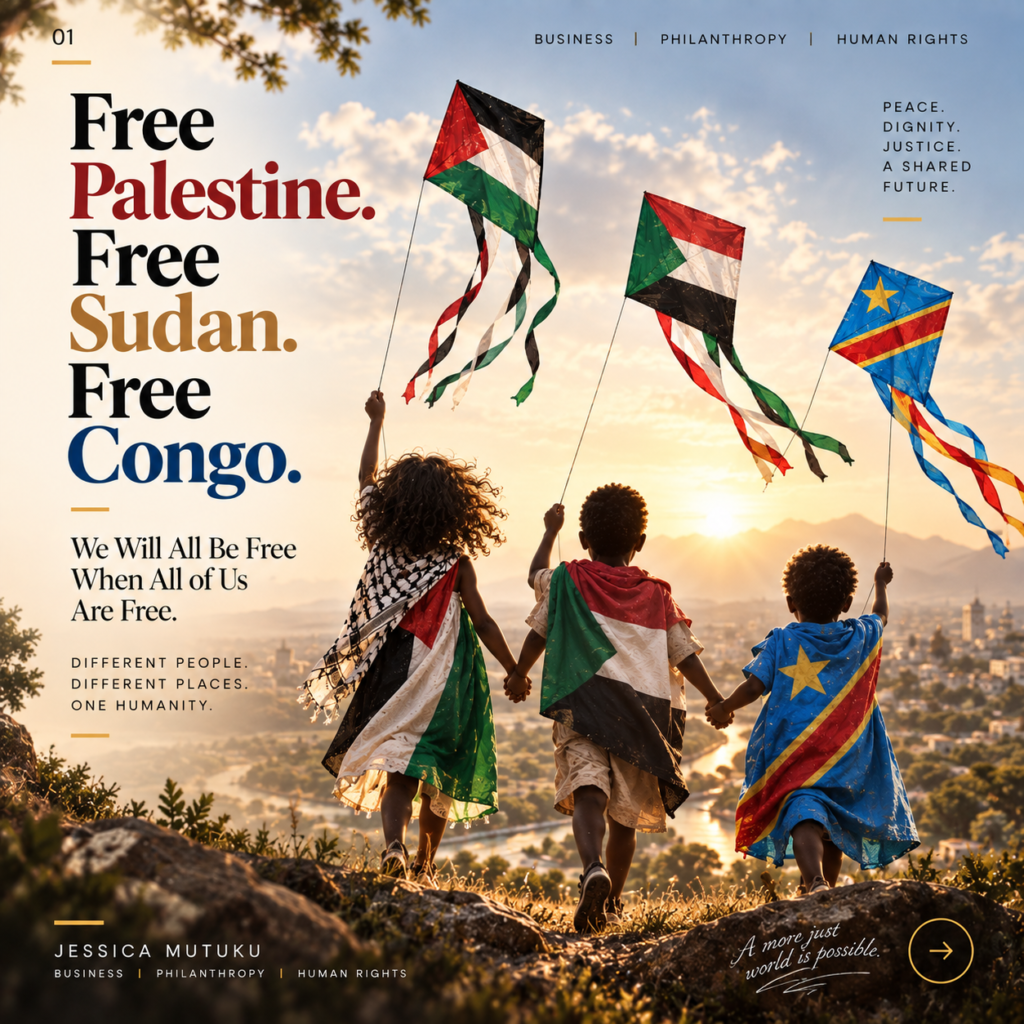
Free Palestine.
Free Sudan.
Free Congo.
I am not drawing the boundaries of the people I care about.
I am expressing a much larger belief.
Free every human being from oppression, persecution and the denial of their fundamental human rights.
Let the child in Palestine matter.
Let the mother in Sudan matter.
Let the family displaced in Congo matter.
Let the people of Syria, Ukraine, Myanmar, Yemen, Haiti and the countless communities whose names may never reach our screens matter.
Let humanity matter.
No One Is Free Until All of Us Are Free
My vision of freedom cannot end at my own front door.
It cannot end at the borders of my country.
It cannot extend only to people who look like me, worship like me, speak like me or believe what I believe.
Because if I ask the world to recognize my humanity, I must be willing to recognize yours.
There should be no forgotten people.
No invisible children.
No suffering we decide is acceptable simply because it is happening somewhere else.
Perhaps the world changes when we stop asking:
“What does their suffering have to do with me?”
And begin asking:
“What kind of world do we create when another person’s suffering no longer moves us?”
I know the kind of world I want to believe in.
One where dignity has no nationality.
Where compassion has no border.
Where a human life does not become more or less valuable depending on where it began.
Where freedom is not reserved for the fortunate.
Because ultimately, beneath everything that separates us, there is something that connects us.
We are human.
And no one is truly free until all of us are free.
Jessica Mutuku
Business | Philanthropy | Human Rights