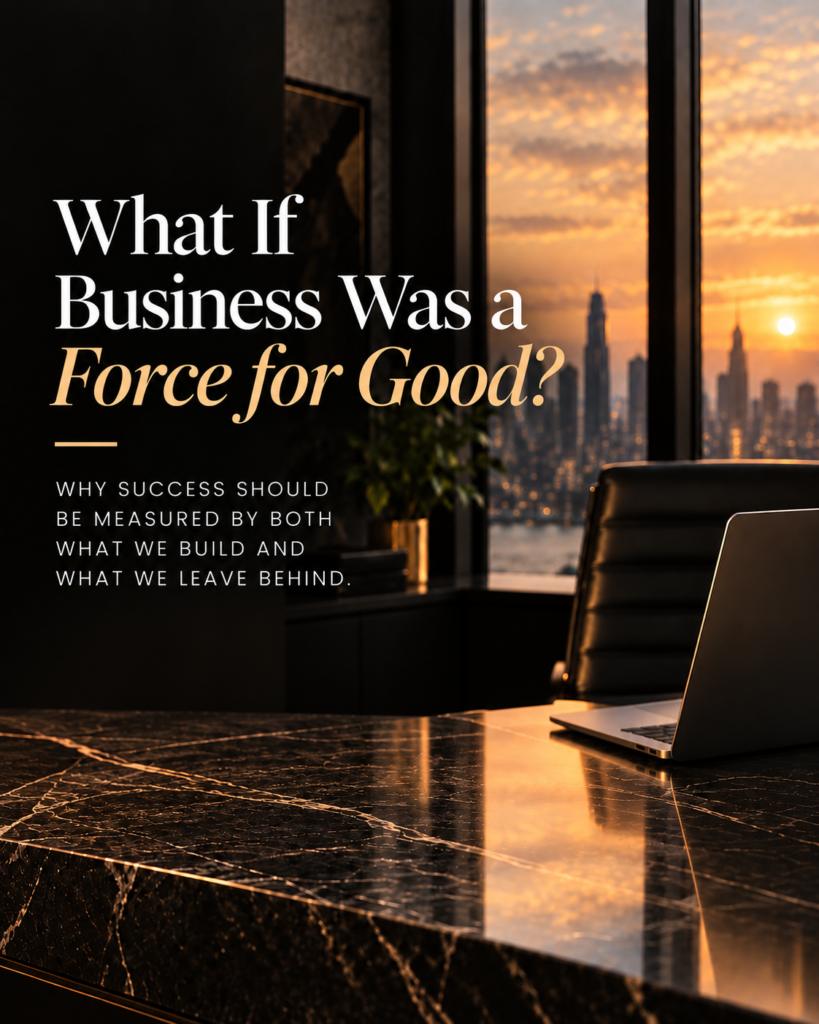
Why I believe success should be measured by both what we build and what we leave behind.
I believe business can be a force for good.
For a long time, we have treated business and philanthropy as two separate worlds.
You build the company.
You make the money.
You become successful.
And then, somewhere along the way, you decide how much of that success you want to give back.
But I have started thinking about it differently.
What if doing good wasn’t something that happened after success?
What if it was part of how we defined success in the first place?
Profit Is Not the Problem
I believe businesses should be profitable.
I believe entrepreneurs should be ambitious.
I believe in building wealth, creating successful companies and generating strong returns.
There is nothing wrong with wanting to build something extraordinary.
Profit allows businesses to grow. It creates jobs. It attracts investment. It funds innovation. It allows ideas that begin with one person to reach thousands or even millions.
But I don’t believe profit has to be the only measure of what makes a business successful.
There is another question worth asking:
Did what we build leave people and the world better because it existed?
That question changes the conversation.
Because suddenly success isn’t only about what a company earns.
It is also about what a company enables.
The Impact of Business Goes Far Beyond Business
Every business touches people.
Employees.
Customers.
Families.
Communities.
Suppliers.
Entrepreneurs.
Sometimes entire industries.
A company can create someone’s first job.
It can give a small supplier an opportunity that changes the trajectory of their business.
It can solve a problem that makes everyday life easier.
It can introduce technology that gives people access to services they never had before.
It can invest in a community others have overlooked.
And when businesses grow, the decisions made inside those businesses can ripple far beyond the walls of the company.
That is power.
And I believe power carries responsibility.
Not necessarily the responsibility to solve every problem in the world.
But the responsibility to recognize that what we build affects the world around us.
Philanthropy Can Begin Before the Check Is Written
This is where my understanding of philanthropy has evolved.
Philanthropy is often associated with giving money away.
And giving matters. There are organizations, communities and people doing extraordinary work that need resources to continue doing it.
But I think philanthropy can also begin much earlier.
It can begin with how we build.
How do we treat the people who work with us?
Who gets an opportunity?
Who gets invited into the room?
What problems are we choosing to solve?
What communities benefit when we succeed?
Are we creating dependency, or are we creating opportunity?
Are we extracting value from the world, or are we also putting value back into it?
These are business questions.
But I believe they are also deeply human ones.
Success and Impact Do Not Have to Compete
I don’t believe we have to choose between building profitable companies and building a better world.
The two can coexist.
A company can generate returns and create opportunity.
It can grow and improve people’s lives.
It can create wealth and strengthen communities.
It can be commercially successful while still remembering the human beings affected by the decisions it makes.
For me, that is what business as a force for good means.
It doesn’t mean every company has to become a charity.
It doesn’t mean profit disappears.
And it doesn’t mean putting a purpose statement on a website.
It means building successful businesses while being intentional about the impact those businesses leave behind.
What Do We Leave Behind?
One day, every title we hold will belong to the past.
The companies we build may change.
The numbers in our bank accounts will change.
The things we once thought were incredibly important may eventually become footnotes in our lives.
But the impact we had on people can travel much further.
The person who received an opportunity because someone believed in them.
The family whose life changed because a parent found meaningful work.
The entrepreneur who was given access to capital.
The community that benefited because a company decided not simply to operate there, but to invest there.
Those stories rarely appear on a balance sheet.
But they are part of what we build too.
And perhaps that is the kind of return we should think about more often.
Not only:
How successful can this become?
But also:
Who becomes better off because it succeeded?
That is the question I want to carry into the businesses I build, the businesses I support and the work I choose to do.
I want to build successful things.
I want them to grow.
I want them to create wealth and opportunity.
But I also want something more.
I want what we build to leave people and the world better because it existed.
To me, that is success.
And that is what it means to use business as a force for good.
Jessica Mutuku
Business | Philanthropy | Human Rights