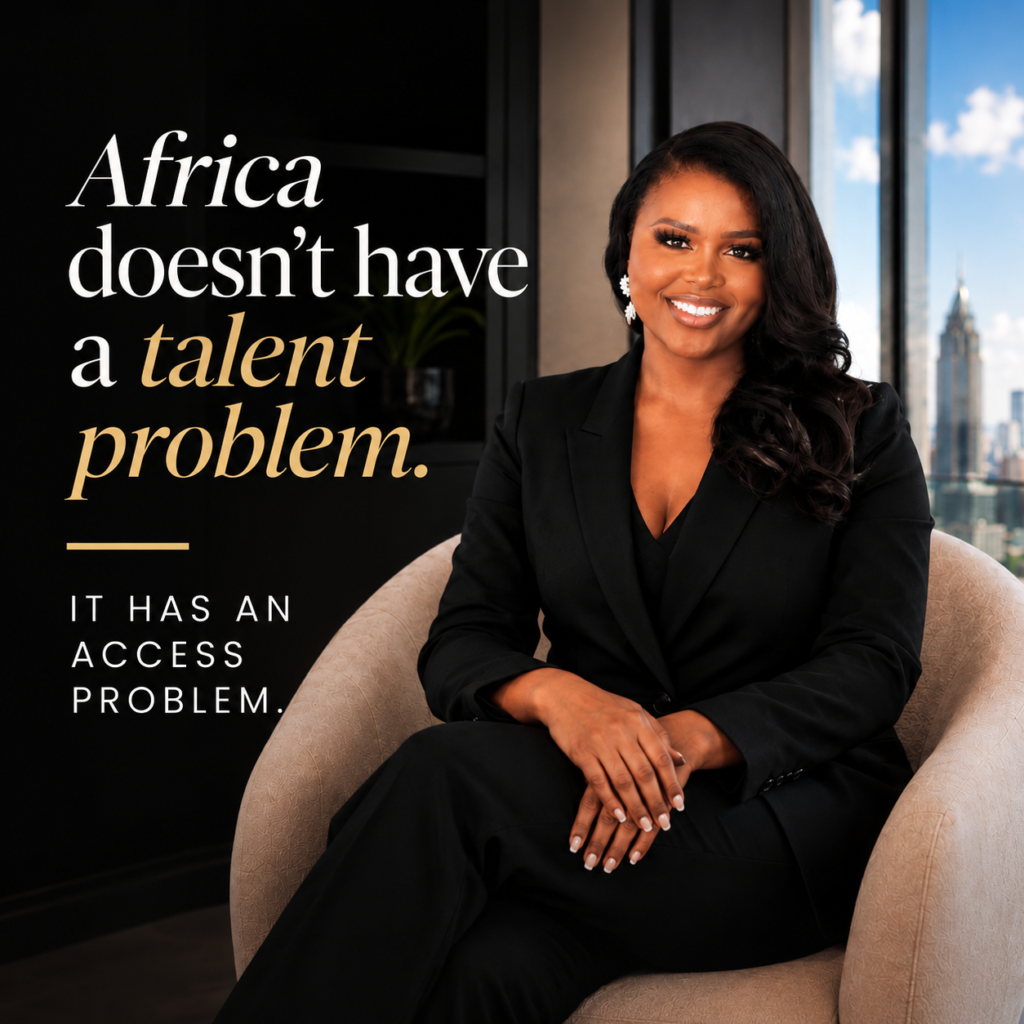
Africa Doesn’t Have a Talent Problem. It Has an Access Problem.
Why Africa’s Next Unicorns Will Come From Builders Who Understand Problems Deeply

There is a question I keep seeing asked: “Why doesn’t Africa produce more unicorns?” At first glance, it seems like a question about talent.
A continent of 54 countries. More than 1.4 billion people. A generation of young entrepreneurs, engineers, creators and problem-solvers. So why aren’t there more billion-dollar companies emerging? I believe we are asking the wrong question.
Africa does not have a talent problem. Africa has an access problem.
The Talent Has Always Been There
I grew up in Africa. I saw brilliant people create solutions with almost nothing. I saw entrepreneurs solve problems because they had no choice but to innovate.
When resources are limited, creativity becomes a necessity. People learn to build around constraints. They create informal systems. They find ways to move money. They build businesses without perfect infrastructure. They solve problems before the world even recognizes those problems exist.
The issue has never been a lack of intelligence, ambition or creativity. The issue has been whether those ideas have access to the resources needed to scale.
The World Often Looks at Africa Through the Wrong Lens
When people look at Africa, they often see what is missing: Limited infrastructure. Unequal access to capital. Fragmented markets. Fewer global connections. But they often miss what already exists:
Deep problem-solving ability. Entrepreneurial resilience. Community-driven innovation. A generation that understands realities many outsiders have never experienced. The same conditions that create challenges can also create extraordinary innovation. Because innovation is not always born from abundance.
Sometimes it is born from necessity.
The Difference Between Copying and Creating
Many startups around the world begin by looking at what works somewhere else and adapting it. There is nothing wrong with learning from successful models. But the next generation of African unicorns will not come from simply recreating Silicon Valley in Africa.
They will come from founders who understand African realities deeply enough to create solutions the world has never seen. Because some of the greatest opportunities are invisible to people who have never experienced the problem. The person who has struggled to access credit understands something about financial inclusion that a spreadsheet cannot teach.
The entrepreneur who has built around unreliable infrastructure understands constraints differently from someone who has always had it. The farmer, mother, merchant, student or small-business owner living the problem often possesses insights that cannot be imported.
The people closest to the problem may also be closest to the solution.
M-Pesa: A Lesson in Understanding Reality
One of Africa’s greatest technology success stories came from understanding how people actually lived. Before mobile money became a global conversation, people in Kenya were already finding informal ways to transfer value, including sending airtime and relying on trusted community networks. The breakthrough wasn’t simply technology.
It was recognizing a reality that already existed and building infrastructure around it. M-Pesa didn’t require people to suddenly behave like consumers in another part of the world. It addressed a real need within the environment in which people were already living.
And that distinction matters.
Technology is most powerful when it understands the human being on the other side of it.
Africa’s Next Chapter Requires Three Things
I believe the next generation of African companies will emerge where three things meet.
Local realities. Founders who understand people beyond statistics because they understand how people actually live, work, spend, save and survive.
Global technology. AI, cloud infrastructure, digital identity, data and emerging technologies can give today’s builders tools previous generations never had.
Technology is the tool. Understanding the problem is the foundation. And finally, scalable impact.
The opportunity isn’t simply to solve a problem for one neighborhood or even one country. It is to build solutions capable of crossing borders, reaching millions of people and, in some cases, becoming relevant far beyond Africa.
Africa Does Not Need Permission to Innovate
For too long, the conversation has been: “How can Africa catch up?” But perhaps the better question is:
“What can Africa create that the world has never seen?” There are problems across the continent that remain unsolved at scale. Financial inclusion. Healthcare access. Agriculture. Education. Logistics. Energy. Identity. Housing. Commerce.
These challenges are real. But inside many of them are also enormous opportunities for innovation. Africa’s future does not have to be defined by replicating someone else’s future.
It can help create the next one.
The Future Belongs to Builders
The world does not need more copies. It needs original ideas. It needs people who have lived the challenges, understood the realities and have the courage to build solutions.
Africa has never lacked talent. What it needs is greater access. Access to capital.
Access to networks. Access to opportunity. Access to technology.
Access to markets. And access to the platforms and ecosystems that allow extraordinary builders to scale. Because when talent meets access, possibility changes.
And the next generation of globally significant companies may not come from where the world expects. They may come from the people who understand the problems most deeply. They may come from Africa.
Jessica Mutuku
Business | Philanthropy | Human Rights